
The other day while waiting for me to pick out a couple of plants in a store, my friend Erin told me that despite her gardening mother’s best efforts, she has never been able to keep plants alive. I laughed, and thought about the things my mother taught me that I’ve retained, the things she taught me that did not stick, and some things she entrusted others to teach me or to learn on my own.
At her memorial service, Mom’s dear friend Mary M. shared that when Helen Longenecker came to Eastern Mennonite College, it was noticed how strong her hands were from years of wielding a carving knife on cuts of meat. I was first surprised, and then not surprised. Mom was highly competent in the kitchen and with cooking, but it was not a passion of hers. I don’t particularly remember her meat carving skills on display, and it was strange to think of her once having strong hands after recent years of diminished strength, including in her hands. Then again, she grew up on a farm and helped with the family business “Longenecker Meats” that included running a sales counter at the Harrisburg Farmers Market. It took her five years of negotiating with her parents to go to college following high school graduation at the age of 16. She worked on the farm and went to market nearly every Saturday during those years, so it’s no surprise she arrived on campus with strong hands and some well-developed skills, like meat-carving, that impressed her friends.
I don’t remember Mom explicitly teaching me how to use kitchen knives, though she was a fast worker in the kitchen and she did love her best small paring knife. Sometimes she even traveled with it to our home in Goshen because our knife collection was not to her standard.
Mom cared deeply about our education, whether school or home-based. My cousin Jennifer shared in a note to me after Mom died that when she was feeling a bit lost as a young mother, Aunt Helen encouraged to her to simply read – a lot – to her young daughter. Fostering a love of books and literature was a primary passion. She also cared that we knew how to sew, another skill she and her sisters developed in childhood. Convinced I would do better with a different teacher for sewing, Mom arranged a robust series of sewing lessons for me one summer with a qualified friend. Mary L. was an excellent instructor and I no doubt nodded politely with my mind wandering as she helped me make some nice things. The lessons, in addition to several home economic units on sewing at school, did not stick. We now have Mom’s last sewing machine in our house, but when we need to hem clothes or have curtains to alter, Dale is the one who uses it, thanks to his one home economics class in high school.
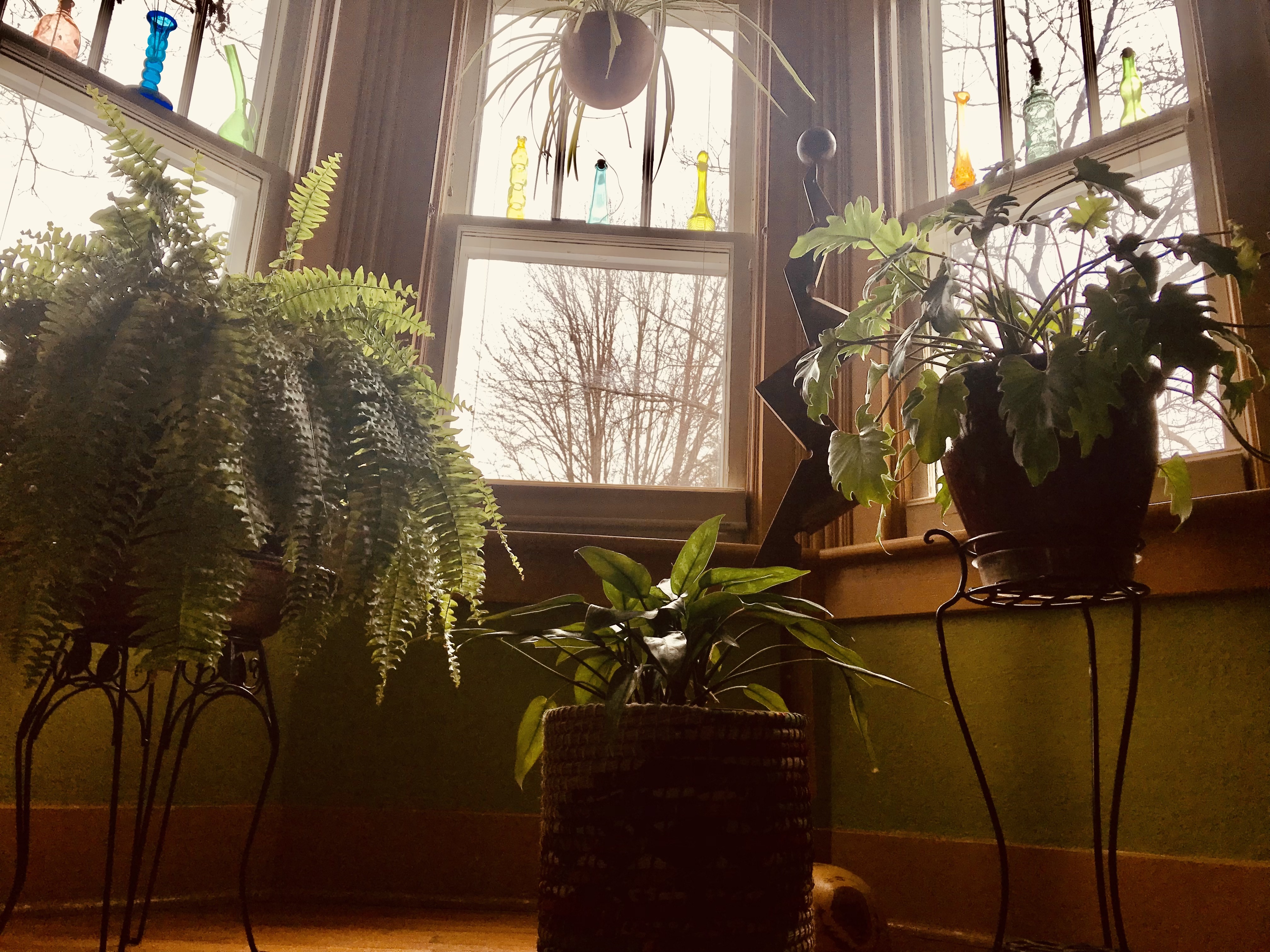
My mom loved house plants, and tended these and flower beds with great care. This winter I have spent a good part of each weekend fussing over plants, buying new starters, repotting, and relocating around the house. This, along with regular spurts of “redding up” keep me feeling connected to Mom in these nearly four months since she died. I especially remember that Mom liked to end every day with an exceedingly tidy kitchen. She often did a final round of kitchen clean up after the chaos of evening homework and other tasks died down and we were all mostly settled in our bedrooms for the night. Leaving a kitchen in anything other than sparkling form before the day ends fills me with discontent, and I thank Mom for this.
One of the many things I appreciate about Mom is that she didn’t take on or communicate the pressure to teach us everything. She believed strongly in education and paid attention to who our teachers were as we followed our nudges of interest. She formed in us an understanding that teachers are in a high calling. She found the best piano teacher she could within a reasonable distance when it became clear something special may be developing in that realm for me, and left work early for a two-hour excursion to my lessons most weeks. She tried to get me to practice each day but I was usually underprepared and studied my music books intensely while she drove me to Quakertown for lessons. I did not know the term “mental practice” yet but I think she, as a text-based person, knew it was a thing, and she took a rare break from talking as she drove to let me work in silence. She developed a warm friendship with that piano teacher, and with many of my teachers.
In my early twenties I lived in a house in Chicago with friends, and after a weekend when a housemate’s mother visited, my housemate told me that she and her mom washed the indoor walls. “You washed the walls? Is that a thing?” I asked. My friend laughed and said she too was surprised, but that it actually made a lot of sense and we could see how it made the apartment shine. I now occasionally wash our walls, and remember that my friend Jan’s mother inadvertently taught me this, not my own mother, who was busy teaching me many other things. I wouldn’t be surprised, if I asked my mom if she grew up washing indoor walls, that she would sigh and say yes, along with a plethora of other chores. I like that she was selective in the art of what to teach and what to let go, what to teach us herself and what to trust others to teach. She worried plenty about us, but also seemed to be grounded in confidence that we would learn what we needed to learn and have good people to teach us.
Last weekend my aunt Ruth hosted a large group of family in the area, including my aunt Sara, who helped her. The table could not fit us all, and when I tried to offer that I would be in a helping role rather than sitting at the main table, my aunts gently said they had it covered and were used to working together. I quickly nodded, aware of the sisterly chemistry and their shared mastery of hospitality. At one point I asked if I could help start gathering up the dinner plates before dessert and Sara said, “a couple people are still finishing up so we’ll wait for that before clearing.” I mentally catalogued that small nuance of hosting a meal, thinking the age of 52 was a little late to learn it. I later wondered if Mom had ever taught me that and I simply forgot. She had her own wonderful style of hosting, with her own set of preferences, but if I asked her now, I’m pretty sure she would say, “Oh I don’t know. Sara, Ruth, Shirley…others…they really are the hospitality experts.”
When my first daughter was born, Mom quickly traveled by train to spend a week with us. She delved into domestic life, cooking and cleaning and holding Greta as much as she could. Once that week when I was resting and Greta started crying from the other room, I jolted off the sofa to go pick her up. Mom gently stopped me and said, “Beverly, it’s ok for her to cry a bit. She’ll learn better to trust that you’ll come if you don’t come rushing immediately.” She taught me what I needed in that moment during the highly anxious fog of early parenting.
I’m sure she and Dad puzzled at times over our parenting style, but they wisely let us develop and prioritize in our own ways. She did not always hold back, however. Once when she was visiting I let the girls watch one of many DVDs we picked up from the library, the classic version of Snow White. Mom watched it with them and grew increasingly agitated, and began offering corrective narrative. She told me later, calmly, that I may want to be more judicious with what they watch at this age. I was a bit annoyed and defensive, but she was right and in good company with scholars who identify highly problematic messages in Snow White, from sexism (including lack of consent) and racism to bad theology. Mom parented with a wisdom uniquely gained from her journey towards feminist consciousness.
I thanked Mom in recent years for being so thoughtful about these things, and acknowledged that perhaps because I was raised by a feminist, I raised my little women with more relaxed assumptions about how they would be formed.
In her later years Mom began repeating stories from our childhood. One of these was the time I wandered out of our house in downtown Lansdale. Within 30 minutes that felt like eternity to her, I was returned to the house in a police car. She had frantically called the police and others, so when someone else called to say they had stopped a toddler girl from walking across Main Street, the police had a pretty good idea where this toddler belonged. After she hugged me tight, I looked her in the eye and said, “Mommy, you lost me.” I sometimes wished Mom wouldn’t bring up the story so often but I imagine it’s one of those she couldn’t stop thinking about as she reflected towards the end of life. I think she worried about us much more than we realized. She hid it a bit less when it came to her grandchildren. When Greta finished her bike trip across the country last summer, Mom was happy for her accomplishment, but was even happier that it was over, telling us, “Now I can stop worrying about it.”
When Greta was a toddler, she mixed up the words “so” and “too” and once said to me, “I love you too much, Mama.” I remember saying back to her, “I love you too much too” and thinking, “and that is the problem.” It’s unimaginable – it’s too much – to think of losing someone within the bounds of this kind of love. Mom did lose a grandchild, Javid, the precious infant son of my older brother and sister-in-law. This loss and others shaped her. She held her life partner, their children, their partners, and their children, with great love from the depth of her being, aware of the possibility of unimaginable loss that comes with it.
In fall 2020 we had a mild panic that Mom wouldn’t be able to vote (in the crucial state of Pennsylvania!) because her driver’s license was expired and mail voting seemed to require that form of ID. Mom said, “I have to vote. I want to be the one who votes Trump out.” We laughed and told her it hopefully would not come down to one vote. She said, “Well, I want to be THE one.” All was worked out, and she voted. On election night when things felt eerily too similar to election night 2016 for a few hours, she messaged to our family group text, “Biden/Harris WILL win. And if they don’t, it will be ok. But they WILL win.” A friend told me, “Oh how I long for a mother who shares my politics.” Shared politics is not a requirement for deep love between parent and child, but it is one of many gratitudes I can count. “You did it, Mom. You voted him out,” we told her later.
Dying comes with the territory of not knowing exactly how it’s all going to turn out for one’s loved ones, let alone for one’s country and for the world. I think Mom knew enough to be confident in the family she raised, and to know she had done her part. She did not think she needed to do it all or be good at it all, or to teach us everything herself, and she helped others relax about this too. At her memorial her pastor said that before saying yes to becoming pastor at their church, he told my mother (who was on the search committee) that he was concerned the congregation had too high expectations for their next pastor. She responded, “All we really need is for someone to love us.” Having just heard this story for the first time, my younger brother added this phrase at the end of our sibling sharing in the same service. “All we needed was for Mom to love us.” And she did that so very well.
 Some Well-Tempered Years
Bev, I am so glad you took the time to gather and share these thoughts here. You made me think of my own 95-year-old mother with new appreciation and of Helen, whom I knew mostly through Stuart, who worked with her on MARP. The ideas of befriending other teachers and of some things “sticking” and others not were fresh ways of viewing motherhood for me. As we age, our lenses become like the optometrist’s view finder.
Thank you, Shirley. Much appreciated. Mom so valued knowing you and Stuart, and felt so supported by him during the MARP years.
Found this through Shirley’s sharing it. My mother died about the same time as yours (last Oct. at age 97) and I’m still sorting out all the things, her special teachings like no other, the blessings she left us. This was beautifully written with much to ponder. Blessings to you!
Thank you, Melodie, for your kind comment! Much appreciated. I have greatly enjoyed your writing over the years.