
• About Me

Some Well-Tempered Years

~ And Other Adventures

Some Well-Tempered Years

Category Archives: Knowing

What is calling out for this?

22 Sunday Nov 2015

Posted by beverlykl in Knowing, Performing, Practicing, Teaching

≈ Leave a comment

FullSizeRender

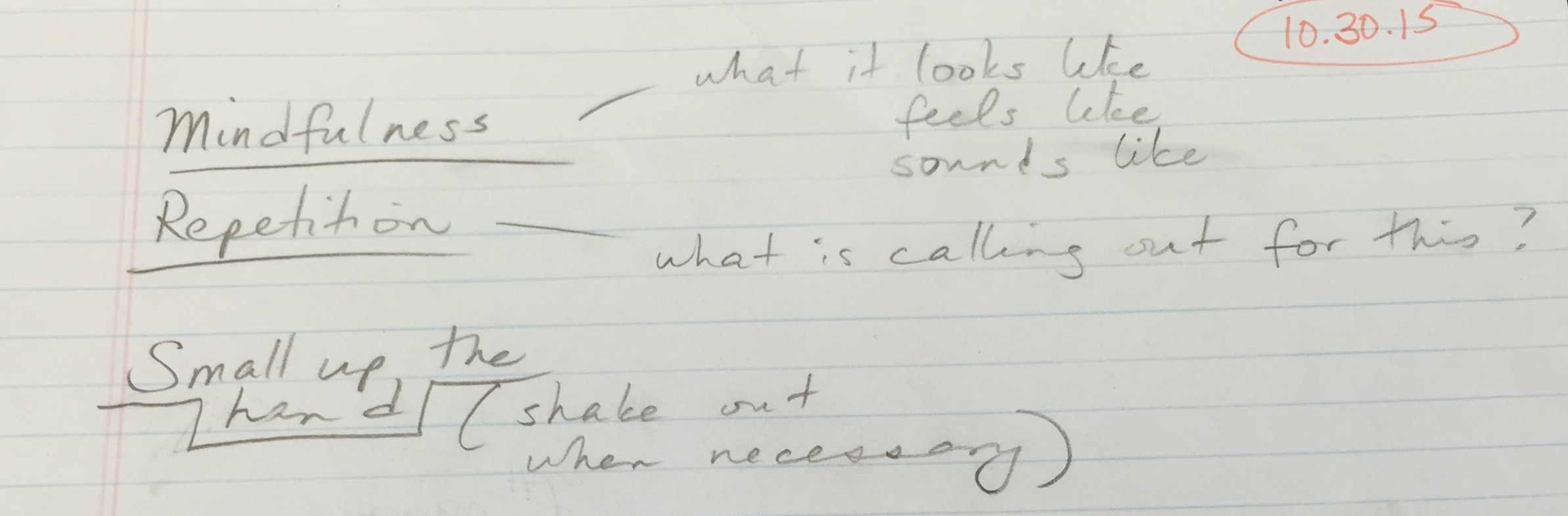
At a recent lesson I noticed the above statements at the top of my student’s assignment. I remembered writing these words, but a week later stared at them as my student warmed up, startled by how directly they spoke to my own practice. My approach to practice is changing because it needs to as I get older, and as my playing changes so does my teaching.

My practice needs to change because I seem to be more nervous about performing these days. My fingers are likely to feel anxious and unsure with material that I haven’t prepared exceedingly well, whereas in the past they would have more confidently sailed through. My current theory is that a loss of innocence that comes with maturity is the increased awareness of what we don’t know.

These three ideas help me focus my attempts to override nerves. First idea: It’s surprisingly easy to do things we are accomplished at without thinking, and we need to counter this tendency to be comfortable in performance. If I’m not mindful of what the positions look like on the keyboard under my hands, what they feel like as my hands and fingers fit in their hundreds of unique places within a given piece, and what the music sounds like…well, I’m sunk. I need to notice these things with a high degree of consciousness when I’m playing alone to be secure with the material when under the pressure of others listening.

Second idea: If I’m not paying attention to what in the music is calling out for repetition, I’m sunk again. It all needs lots of repetition to be secure, but there are sections, some very small, that need an absurd amount of repetition to be really known, especially in nervous conditions.

The third idea is more elusive, referencing a phrase I remember from my childhood. When my family lived in Kingston, Jamaica, we sometimes took “mini-buses” (large vans) as public transportation. A mini-bus would typically look impossibly full as it approached the bus stop, but the driver’s assistant hanging out the door gestured for us to climb on and would holler, “Small up yourselves!” to those already in the seats and in the aisles. Sure enough, more room could be made.

At the piano it’s easy to let tension settle in the hands, and some of the demands of the music require the hand to linger in an awkward stretch. The natural state of the hands when we shake them out and let fall at our sides is quite supple and compact, and the more we maintain this as we play, the better. Reminding myself and my students to “small up the hand” is now a familiar technical point of reference.

It amazes me how much I keep learning about playing and teaching piano, after some 20+ years of active work in the field. This month most of my individual practice has been for a temporary job at a church that integrates the keyboard into its service in a way I find very rewarding. When I think back on big pieces I played in my twenties, the shorter form classical works and hymn arrangements I’m practicing now can make me feel apologetic. I scold myself when I feel this way, because this music contains the essence of all I have learned to do – evenness, clarity, voicing, phrasing, articulation, characterization – and deserves my best effort.

Now in my mid-forties, these pieces that aren’t as difficult as the big pieces I played more than two decades ago can still be plenty demanding. At the piano it’s maddeningly easy to crash into a wrong chord or to stumble through a run. I have to ask myself more honestly where the music is calling out for repetition. And I have to pay better attention to my body, to keep it relaxed and to find the fingerings and maneuvers that allow my hands to stay in their naturally small and relaxed state.

Since the blog started as a project about Bach’s Well-Tempered Clavier Book One, I’ll close by verifying that I’m still working on this. On a good day I am obedient to the daily plan I have for the Bach, which is to review a set of four preludes/fugues assigned for that day. They are all in my fingers now to varying degrees of comfort. They need a lot of time to settle and develop, more time for mindfulness, more repetition where it is called for, and more discovery of how a small and relaxed hand can make the work of playing Bach look, feel and sound easier than it is.

From half to full knowing

31 Tuesday Dec 2013

Posted by beverlykl in Knowing

≈ Leave a comment

There is a story I heard about Vladimir Horowitz that may or may not be true — I cannot recall who told me, or find verification. Horowitz, one of the most famous concert pianists of the 20th century, was practicing in his Manhattan apartment in a relaxed state, free from the stress of a critical audience, when he heard shuffling feet in the next room. The sound of his cleaning woman was enough to bring on the nerves and an awakened awareness of passages where his fingers were not as comfortable as he thought they were.  He shifted into high gear and practiced with more care than when he thought he was entirely alone.

The idea of this acclaimed artist feeling nervous when his cleaning woman was close enough to listen is both comforting and revealing to me. It suggests how universal this being human business is and how important it is to practice the heightened consciousness that comes with the pressure of an audience. When practicing in my childhood home I experienced this state of consciousness when my Dad would briefly stand by the piano watching me me practice. My Dad is not a pianist nor someone I felt undue pressure from to impress at the piano, but his attentive listening and watching was enough to make me focus differently and help me recognize where my fingers lacked confidence.

My students feel the same way when they play in my studio and experience the frustration of the performance not going as well as it did in the practice room. I used to respond by focusing almost entirely on strategies to address performance anxiety until I observed a masterclass at the Goshen College Piano Workshop a few years ago. The performer, a wonderful pianist, had several memory slips that she struggled to recover from. Her stress and exhaustion when finished was evident as she said, “I KNOW this. Why can’t I play it better under pressure?” The masterclass teacher kindly observed that when this happens we need to acknowledge that the main issue at hand is that we may not actually know the music as well as we think we do. Nervousness, a real issue for all who perform, is much tougher to overcome if we have any doubt about our preparation. He then shared various techniques for ensuring and testing our knowing to such an extent that we are able to stare performance anxiety in the face and say with true honesty, “I see you and feel you, but I conquer you because I KNOW this material.” Supplemental practices such as breathing and meditation exercises also help, but perhaps the ultimate way to overcome nerves is to be supremely confident with what we have prepared.

Even though I was taught this same message by my own teachers and experiences (see this earlier post), the masterclass mentioned above was an important turning point for me as a teacher and musician. For many years I explained away any trouble in performance as all about nerves, not recognizing my own lack of knowing. This is easy to do when skill level sometimes camouflages reality.  In my piano practice there is an exciting breakthrough point with difficult material when the music is finally “in the fingers” after lots of hard work — I’ll call this half knowing.  This stage is where I have problems recognizing the limits of what I know. In moving from half knowing to full knowing, I now try to engage in lots of testing by trying to capture a good unedited recording the piece.  For less unforgiving testing than a recording device I’ll ask someone nearby to sit by me and watch my hands closely while I play. In practice I make sure I can start at any measure of the piece and that my hands are as comfortable playing alone as they are together.  I practice the piece and listen for evenness at different speeds: very slow, very fast, and at its ideal tempo. If I am working on memorizing, I depart from the piano and close my eyes and imagine my hands playing every single note of the work.  Finding out where I lose it as I think my way through the piece sends me back to practice until I feel ready to test again for fully confident knowing.

There are times when an ideal level of knowing is not possible — if I’m asked to accompany a student in performance at the last minute, I have to rely on my sight reading skills and take a different kind of musical journey, one with high adrenaline at the somewhat terrifying thrill of playing something I haven’t fully prepared. Expertise allows the privilege of winging it from time to time. But too much of this puts me at risk of a lazy arrogance that usually comes before an unfortunate fall.

I don’t want to diminish the reality of debilitating performance anxiety. Indeed, Horowitz himself struggled with this to a great extent, with various extenuating circumstances.  There are times when we do the work, only to find the fear cannot be conquered. Other responses and strategies are necessary in these situations. However, without an honest accounting of what we do and do not know, we may too easily explain away what happened and lose the opportunity to achieve fully confident knowing the next time.  While I cannot confirm the veracity of the Horowitz story above, I love the concept behind it because it reminds me that any listening ear can help us know what we really know.

Ways of Knowing

23 Tuesday Oct 2012

Posted by beverlykl in Knowing, Learning, Music Theory, Practicing, Teaching

≈ Leave a comment

The older I get, the more I know what I don’t know.  In high school and college I played piano with a clueless bravado that allowed my fingers to fly confidently over notes my brain did not fully understand.  Somewhere along the way I became a good sight reader. Was it those adolescent years in Kingston, Jamaica where I had more free time to practice?  Was it the high school choir accompanying I eagerly did?  My piano teacher in high school required regular playing from the hymnal — did this make me a good sight reader? Did it have anything to do with my constant intake of the written word?  The mysteries of why some pianists become good sight readers of Western notation and why others (often some of the best musicians) need more time to absorb the page in front of them are an ongoing hot topic in music pedagogy circles.  Good research is pointing the way to a combination of experiences and strategies.

However the mysteries are solved or remain, I better understand the downfalls of my sight reading abilities and sometimes wish I read less well. In college I was greatly challenged and wonderfully taught, and I played a lot.  But, perhaps in part because there was not enough struggle to read those notes, my knowledge became technical fairly quickly and theoretical awareness rarely surfaced in my individual practice.  My moment of truth (I think each musician has one) occurred in the spring semester of my junior year when I crashed and burned in a public performance of a Beethoven Sonata movement (it was Op. 10 No. 3, movement one, if you must know).  I had played it through from memory many times on my own and in front of my teacher, but I didn’t really know those notes on an cognitive level. I went into the high-stakes environment with an unfamiliar feeling of unease, perhaps finally mature enough to be subconsciously aware that other ways of knowing weren’t there to reinforce the motor-muscle memory in the fingers. The disaster and ensuing tears of mortification led to some of the most important conversations I had with my professors and began a turning point in how I practiced.  The innocence of clueless bravado lost, a new path was needed.

And yet, this turning point seems to be one of the longest curves of my life.  Now more than twenty years later, I still struggle to really know.  Today while practicing Bach’s delightful fugue in A major from WTC book one I felt that familiar learning-too-quickly habit take hold, the notes coming easily and my fingers and ears giddy with what they were doing and hearing — too much intake, too fast, without enough struggle to understand.  Of course the brain can’t be truly bypassed in this situation, and enough repetitions will eventually result in some actual knowing.  But, if I bypass the knowing struggle as my fingers weave their way through the material, I’m only inviting future trouble. So, I keep working at deepening the ways in which I know the music, in essence making sure the struggle is early in the process rather than late.

Here are the ways of knowing I now try to activate.  (These ideas are gathered from my teachers, my students, and various readings, but were particularly solidified when I read Geoffrey Haydon’s chapter “Memorization via Internalization for the Intermediate Student” in Creative Piano Teaching by Lyke, Haydon, and Rollin, 2011.)

1. There is the technical knowing, which I value more and more for its importance as I get older, even as I recognize it was too often my only route of knowing back then.  My fingers need more accurate repetitions than ever, to really have it.  I’m better at recognizing where they are close to faltering even if I can get through that moment, because under just a little bit of pressure, stumbles will happen in those places. There is no room for doubt in my fingers.

2. There is the theoretical knowing, which can seem overwhelming (so many notes!) until I remember that theory is any way of naming what I am doing.  I need ways of talking about musical passages, of identifying beginnings, middles, and endings.  Western music theory is my best path for this, even if I name a passage as simply as, “The place where the hand does the back-and-forth thingy with the E major triad.”  I have to be able to talk my way through an entire piece in one way or another.

3. There is the visual knowing, which has two parts.  First, I am increasingly aware of the photographic memory that develops when I’ve read a page of notation so many times.  (This is a useful way for me to review my knowledge, though not what I want to focus on in a memorized performance).  The other visual is recognizing and knowing the way my hands look on the keyboard when playing a given passage — the amazingly diverse topography found within those black key groups surrounded by just seven white keys.  Away from the piano, I find time to picture myself playing the piece; where I lose the view are places I need to better reinforce in my practice.

4. There is the aural, the knowing of the ears.  I’m learning to sing various melodic lines and practice improvisation on the patterns and harmonies from the music I’m learning.  Being able to trust my ears and improvise my way out of a trouble spot helps me integrate what is written. In the same way I envision myself playing the keys, I close my eyes away from the piano and hear my way through a whole piece to check my aural knowing.

And, finally:

5.  There is the body’s way of knowing.  Awareness of the physical gestures in use is an important part of this.  I am trying to pay attention to how different mechanisms are at work as the body plays various passages, from the feet to the sitz bones to the shoulders, head, face, arms, and fingertips.  Exploring and refining what feels best as the body experiences the music helps helps me recognize and trust the body’s knowledge of the musical experience.

Two final connections.

Until the most recent general education revision, the liberal arts curriculum at my college required each student to take one of two Bible courses  — either Reading the Bible or Knowing the Bible. In my advising sessions I often needed to remind myself that Reading the Bible was for students with previous biblical study background; it seemed to me that the other way around made more sense — that the more advanced course would be Knowing the Bible.  Our Bible/Religion department’s rationale was that you cannot read the Bible until you know how this canon was formed and organized.  Reading the Bible went much deeper into content and interpretation, and was for students who already understood the structure of the volume of books and how to approach a reading encounter with it.  This paradigm reminds me that much knowing goes into reading.  I know a lot already to be able to sight read music well, and it is a vital skill in my line of work. Knowledge makes reading possible. Repeated and mindful reading of any text leads to greater insight and satisfaction.

Recently I’ve noticed a change in how I respond to a familiar comment from students in their lessons. “But I know this.  I don’t understand why I’m not playing it better here.”  In the past I used this as an opportunity to explore nervousness and how to play through it.  Now, recognizing that insecurity about knowing (knowing what you don’t know) is often the main source of anxiety in performance, I respond, “You must not know it as well as you thought.  Let’s look at how you can practice so you know it exceedingly well, in a lot of different ways, and we’ll see if that makes a difference.”

I am still one who needs this lesson the most.

I am not that important. I am loved beyond measure.

24 Friday Aug 2012

Posted by beverlykl in Knowing, Learning, Teaching

≈ 4 Comments

A shift has happened.  Schedules are fully in place — kids’ school and activities, full-time work, and evening meetings or events.  Summer was a gift, especially this first one in five years without doctoral demands and with children old enough to do their things while I did mine.  I am thankful for what we had, but the structure we inevitably needed has inevitably come.

Time at the piano and time to write about it will require more commitment and planning than before. When I set out on this project, though, I added the “and other adventures” to the title so if the practicing wasn’t happening I could write about what was happening.  This week one of the happenings was this:

These notes are from yesterday’s teaching faculty workshop.  Some years guest speakers give the workshop and these individuals are often inspiring and provoking.  This time we heard from our own colleagues on three themes under the meta question, “What is Unique about a Goshen College Education?” — Philosophical/Religious Underpinnings, International Education, and Pedagogies Within and Across Disciplines.

It was a great day. I geeked out on my love for Goshen College and my love for pedagogy.  Some highlights:

• From John D. Roth’s new book Teaching that Transforms (chapter 3 was one of our readings for the day) an exploration of the dispositions found in good teaching: curiosity, reason, joy, patience and love.  John, Professor of History, offered an Anabaptist theological framework for pedagogies anchored in our senses, and for the act of learning as a sacred act, as an act of worship.

• Kevin Gary, Professor of Education, spoke of a “great spiritual truth” that holds two ideas in tension — 1. you are not that important; 2. you are loved beyond measure.  Experiential learning happens best when we both suspend self and open self to the experience. I also learned from Kevin that I need to read some T.S. Eliot.

• Beth Martin Birky, Professor of English and Women’s Studies, reflected on how leading Study-Service-Term took her outside of her specialties but also deepened her scholarship as she began a multi-year research project about women in Costa Rica. Her commitment to personal engagement with the women she wanted to learn from and her ability to creatively engage college students in her research are models I want to remember.

• Ross Peterson-Veatch, Associate Academic Dean, suggested a working theory for our teaching, a bridging concept to help students: 1. know what to pay attention to and what not to pay attention to; 2. have a structured experience; 3. have time for structured reflection; and 4. make a commitment to what is known now that wasn’t known before.  This theory reminded me of the educational philosopher Maxine Greene’s trio of steps for meaningful engagement in the arts (from her book Releasing the Imagination): 1. exposure; 2. active engagement; and 3. reflection.  Ross deepened this for me and also arranged it as a quartet with the addition of commitment.  Perhaps this commitment helps us avoid outcomes where we “had the experience but missed the meaning” (from the 3rd quartet of Four Quartets by T.S. Eliot — Thanks, Kevin).

There was more to this geek-fest — a “History of Goshen College in 12 Minutes” by Steve Nolt, the story of Study-Service-Term by Tom Meyers, the role of language-learning on SST by Dean Rhodes, and pedagogical vignettes by about ten other colleagues.  Kathyrn Meyer Reimer, outgoing faculty chair, did a masterful job of organizing the day and I’m grateful.

And now, with my head full and my hands too quiet, I will play some Bach this weekend. I will trust that my own art-making will in some way nurture my teaching disposition into more curiosity, reason, joy, patience, and love to offer my students. I will encounter, experience, reflect, and commit to what is learned. I will remember I’m not that important.  I will be ok with this because I know I am greatly loved.

A dead white guy? Really?

29 Sunday Jul 2012

Posted by beverlykl in Knowing, Learning, Motivation, Practicing

≈ 3 Comments

I am going to learn the Well-Tempered Clavier Book One by J.S. Bach this year.  I thought at this point in my life I’d be exploring music by living classical composers, finally learning the language of jazz, or even on my way to achieving my dream of being the next Joan Baez. Instead — a dead white guy?  One of the deadest, possibly most over-exposed white guys of them all?  Really?

But.  It is this music that I’m most drawn to these days. My fingers experience a unique joy as I play it, my brain is extra stimulated as I read, analyze, and listen to it, and it makes me sigh deeply and often for its emotional content. I feel a strong need to learn the entire collection (book one, that is).  Now.  This year.

For weeks I’ve been sightreading through WTC book one and reading commentary and analysis on the preludes and fugues. Starting August 1, I’ll begin some sort of disciplined process to learn on a new pair every two weeks with the hope that I’ll know all 24 within a year.

What is a disciplined process? What does knowing mean in this context?  Why do my fingers like this music, what does it do for the intellect, why does it make me sigh?  What thoughts about learning, teaching, leadership, relationships, politics and more might emerge while my brain and hands work through it?  These questions will be part of the experience, which I will process on this blog.

If others read this and experience the process in some way with me, I’ll be grateful to a very dead white guy for enabling that connection.

Recent Posts

  • You can get there from here
  • Some Sabbatical Reflections
  • Singing for Ceasefire
  • You all know this precocious little boy
  • Helen Longenecker’s Dilemma

Archives

  • December 2024
  • April 2024
  • January 2024
  • November 2023
  • May 2023
  • November 2022
  • March 2022
  • August 2018
  • November 2015
  • August 2015
  • January 2015
  • August 2014
  • May 2014
  • January 2014
  • December 2013
  • November 2013
  • August 2013
  • July 2013
  • May 2013
  • April 2013
  • March 2013
  • December 2012
  • October 2012
  • September 2012
  • August 2012
  • July 2012

Categories

  • Family
  • Higher Education
  • Knowing
  • Learning
  • Motivation
  • Music Theory
  • Peace
  • Performing
  • Practicing
  • Protest
  • Teaching
  • Time
  • Uncategorized
  • Writing

Meta

  • Create account
  • Log in
  • Entries feed
  • Comments feed
  • WordPress.com

Blog at WordPress.com.

  • Subscribe Subscribed
    • Some Well-Tempered Years
    • Already have a WordPress.com account? Log in now.
    • Some Well-Tempered Years
    • Subscribe Subscribed
    • Sign up
    • Log in
    • Report this content
    • View site in Reader
    • Manage subscriptions
    • Collapse this bar
 

Loading Comments...