• About Me

Some Well-Tempered Years

~ And Other Adventures

Some Well-Tempered Years

Category Archives: Uncategorized

I love it and I’m grateful to have it

15 Saturday Aug 2015

Posted by beverlykl in Uncategorized

≈ 3 Comments

Something exciting happened the other day. In one fell swoop, as my spouse notes, I exceeded his expenditures over 20 years on his classic car restoration hobby, though not by much. I’m slightly skeptical of the math on this, but the one fell swoop part is true.

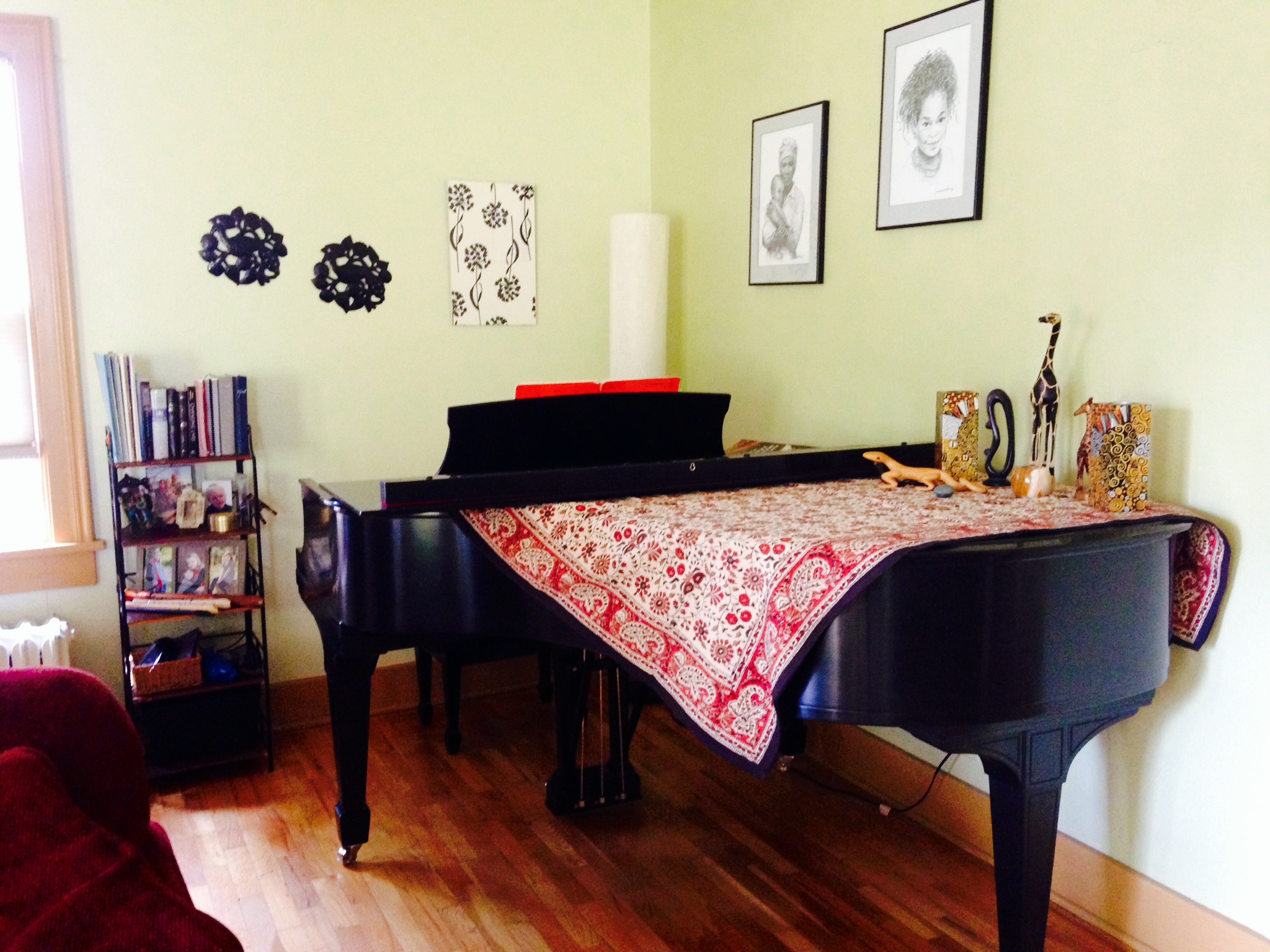
I bought a piano. It’s a rebuilt 1926 Steinway L, from the “golden age” of the Steinway grands. It’s beautiful and so fun to play.

We’re freaking out about it when we’re not rejoicing over it. It was delivered Friday but we forgot to call our home insurance company. Lying awake in bed that night Dale said, “What if we have a fire and lose it?” I said, “I could care less about the piano if we have a fire, as long as we are all safe. Also, I promise we won’t have a fire before Monday when we’ll call the insurance folks.”

We’re feeling some guilt about going big on this, bigger than first intended. To keep things in perspective we remind ourselves of our modest spending elsewhere. We tell the children, “It’s an investment. We got a favorable rate on the loan, and these Steinways appreciate so much that it’s like putting money in savings each month.”

I worry about being judged. I judge myself. This purchase demonstrates our privilege and access. I may need a piano, but this one exceeds my need. There would be much more responsible and just ways to use our money.

I make more excuses. I’ve been thinking about doing this for a while. We’re supporting a local craftsman and business. I want to have several decades to enjoy the last piano I’ll ever buy. It will get played. A lot. We’ll be good stewards of a historic instrument.

These moments of panic, guilt, and justification are deeply rooted in how I think about money. It’s probably healthy to work through this with any large purchase, a process that could lead to positive new commitments and priorities.

No one is asking me to justify, and it may be most elegant to simply say, “I love it and I’m grateful to have it.” I guess I’m not doing the elegant thing with these reflections, but I’ll try in future conversations. I love it and I’m grateful to have it. And now I’ll go play it.

photo(1) copy

Finish What You Have Started In Me

09 Saturday Aug 2014

Posted by beverlykl in Uncategorized

≈ Leave a comment

Storytelling at Assembly Mennonite Church, August 3, 2014

Now that I have it on paper in front of me, my temptation is to post this story on Facebook, and invite you all to just go read it there.  Speaking in this space feels a lot more scary and I’d love to go hide behind one of my keyboards — piano or computer — right now.  But, I am also grateful to be in front of you today with this story and a few thoughts for Assembly as we approach 40 years as a congregation.

Mothering God gave me birth and a childhood home among the rolling hills of southeastern Pennsylvania.  When I was in grade school my family moved to the home on Allentown Road that my paternal grandparents built and raised nine children in.  My roots extend three hours further west to near Harrisburg where Phares and Emma Longenecker ran a farm and butcher shop with the help of their seven children, including my mother.

My childhood years, mostly spent in Lansdale, the final stop on the north regional rail line from Philadelphia, tell a story of being both blessed by many advantages and challenged to do better and be better. This story relates to my experiences among you at this 40-year old congregation, and to my hopes and dreams for our future.

When I was nine years old my family went to Jamaica for a term with Mennonite Central Committee.  I was a below average elementary piano student up until this point, but in Kingston my parents found a teacher who demanded new levels of courage from me, from passing the two very large dogs on her front porch to grappling with the difficult pieces she assigned.  In addition to spending many hours at the piano, my wide eyes took in both the rich culture and devastating poverty of the island.  My values were greatly shaped by our Jamaican friends, as well as by the MCC and other relief and development workers we spent so much time with. I was nearly 12 when we came home, and by then my fingers could play pretty fast.  Returning to wealthy, suburban Montgomery County was strange and full of culture shock.  I felt really different from other adolescents in this context, a difference that felt like a great imperfection at the time.

We settled back in to my home church, Plains Mennonite in Hatfield, which will celebrate its 250 year anniversary next summer.  It was at the Plains church and surrounding community that my musical abilities continued to be nurtured.  I remember a particularly low point in early high school years, when it seemed clear to me that my academic and athletic gifts were not as stellar as those of so many exceptional high achievers all around me.  Over time I would learn that the status of our abilities, perceived or real, in any one moment, should not define us.  But at that moment, when I was wallowing in what seems now like adolescent self-pity, a desperate phone call came in at home.  The accompanist had backed out of a community musical theater production.  Rumor was that I could sight read music well; would I be willing to step in?  That evening’s rehearsal was a busy, thrilling blur as my eyes and hands labored hard at the keyboard, but I could do it — I could play this music I had not even practiced, and I was being useful.  During a rehearsal break the director came to the piano and gushed over my skills.  I escaped to an empty Sunday School room and felt a strange, visceral need to say out loud between tears of relief and joy, “Thank you.  Thank you.  Thank you.” Like David in Psalm 138 I was so grateful.  I had a gift. In the psalmist’s words, “The moment I called out, you stepped in; you made my life large with strength….finish what you have started in me, God.”

This was turning point on my journey as a musician and person of faith, though not a sharp turn. My musical work gradually took on more seriousness of purpose.  In college and grad school I learned how to really practice, but my naive ability to perform with ease was threatened as I learned more and more what I didn’t know and how I did not measure up.  I wanted more excellence and perfection from myself all the time, and yet it was increasingly difficult to achieve.  Moments of failure were important and good, all the more so because I was given opportunity, time, and grace to improve.

A paradox emerges with maturity — some gifts fade, while others are strengthened.  I’m learning, though I still need hard lessons now and then, that process matters more than perfection and relationships matter more than accomplishments.  What a gift, that we are not finished individuals and that we can keep growing.

I Peter chapter one suggests a Christian journey that embraces effort and strives to something good, and that this results ultimately in love.  The writer urges us to make every effort to add goodness to faith, knowledge to goodness, self-control to knowledge, and perseverance to self-control. Add godliness, and then mutual affection.  And finally, add love.  Love is the ultimate part of this long formula for faith.  The first four attributes — goodness, knowledge, self-control, perseverance — seem certain to take us on a path that ends in some state of perfection or at least excellence.  But instead, we are pulled back to God, to affection for each other, and ultimately, to Love.  Faith, we are reminded, is not about perfection.  It’s about Love.

As my formal piano studies came to a close and I realized just how many classical pianists there are in the world, and how many very good ones, a life of piano teaching began to seem like a respectable way to move forward.  Moving to Chicago for my first teaching role, and to check out living close to this guy Dale I had met, brought me into some new and exciting company: a quirky group of friends connected to the Mennonite Volunteer Service Unit and Catholic Worker Movement, who worked in public health, social work, education, and community development. We worshipped in a house church, shared lots of meals, and played hours of ultimate frisbee in city parks.  By the time the Chicago friends accomplished their goal of getting me to join them on a dumpster dive, I was learning that being different was ok.  More than ok.

We moved to Goshen in 1995, at the beginning of Assembly’s third decade. Here I found people who were also a little bit different, a high achieving group that was ok with imperfection. Here we found a warm and welcoming community that thrilled us with strong singing and would not let us forget about the unjust ways of the world around us.  It is here that I learn so much from all of you.  Just as experiences and people in Lansdale, Kingston, Goshen, Princeton, and Chicago challenged me to do better and be better, so has this Assembly the past 20 years.

And yet, here I am, approaching the mid-40’s.  Here we are, approaching 40 years as a congregation.  I confess I don’t always know how to be better, just as we as Assembly seek each other’s vision and wisdom about who and how to be in the future.  In a world full of so much hurt, what is the goodness we should be pursuing and creating, the kind of goodness that aims for Love as its ultimate message?  My childhood experiences set me on an unexpected path to strengthen a craft that happens in a small, confined place. And while I’m blessed to have found a professional home at Goshen College that both includes and expands opportunities beyond this small space of the piano, I am, like Assembly, wondering how to use my gifts to more meaningfully serve my community here and the world beyond.  God has not finished what was started in me.  God has not finished what was started in us.

What synergy might we find between our individual moments of restlessness about how we are living out the gospel of love, and the collective wondering of this body of believers?  We are, after all, ideally each other’s best resources for spiritual direction and inspiration.  I offer three possible points of vision for us.  These are interrelated commitments Assembly began 40 years ago, but God is not finished with us yet.

First, my hope is that Assembly always believes in the place of rejuvenation and beauty that church can be.  Although church comes with much baggage for many of us, including me, we make a commitment of attendance and involvement because the moments of finding strength in worship and fellowship are so real. Flashes of imperfect beauty in music, words, visuals, preaching, sharing, and responding make me breathless every week.  This precious space we have together will not become any less important as our confusing world careens towards more uncertain outcomes all the time.  Let our worship and the teaching we offer and receive here always be a refuge that both heals and transforms.

Second, I hope we will continue to find new ways to extend the love we experience in this place of refuge beyond these walls.  Assembly’s budget priorities are one critical way we extend love.  But I know that I find it too easy sometimes to use my money and my politics as cover for not doing more with my time, which I guard too closely.  With your help, I can do better. With each other’s help, perhaps our 40’s can be a time of greater personal connections with our local community.  When I think of some of you, I know that in your teaching, your counseling, your medical practice, your community organizing, and in so many other ways, you are regularly moving in and among a hurting world.  Others of us may easily become stuck in bubbles of academia or business or technology.  As we approach our fifth decade, how can we challenge and encourage each other to be personally connected to those who are suffering in our communities, in our country, and in our world?  What new project or initiative might have us relate to a school, prison, social service agency, or group of immigrants?  How can our individual and collective gifts and passions be used to extend the strength of this faith community, and how might we be transformed in doing so?

Third, let’s not forget to pray.  Here I speak with extra humility as I so poorly live out the spiritual discipline of prayer.  But, I believe we pray in many different ways — in words, in song, in art, in craft, in nature, and in silence.  We pray together and we pray alone. Indeed, when our good effort, our activism, politics, money, and relationships are not enough to transcend and transform the moaning of the earth, we must remember to call out, to ask God to step in.

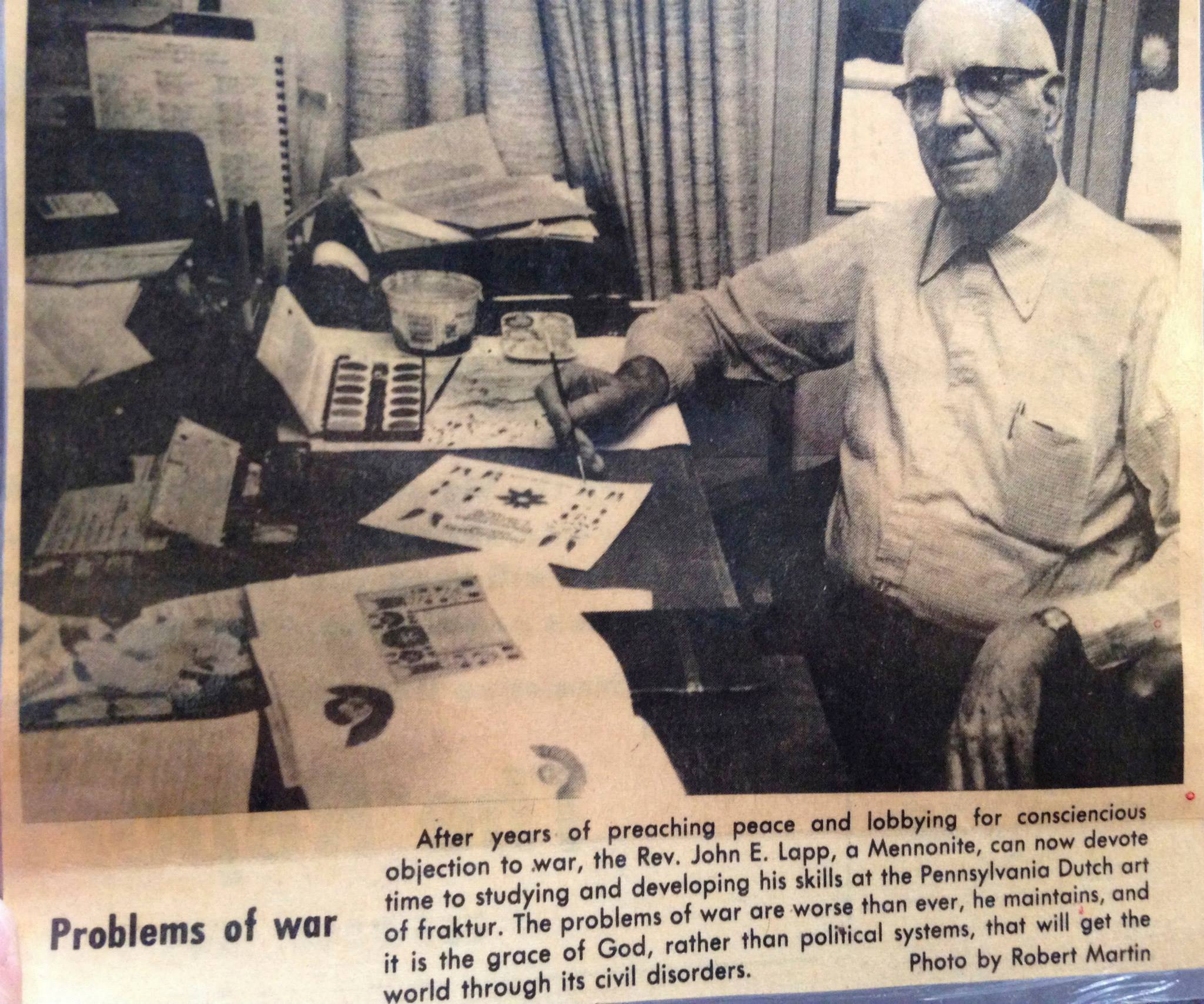
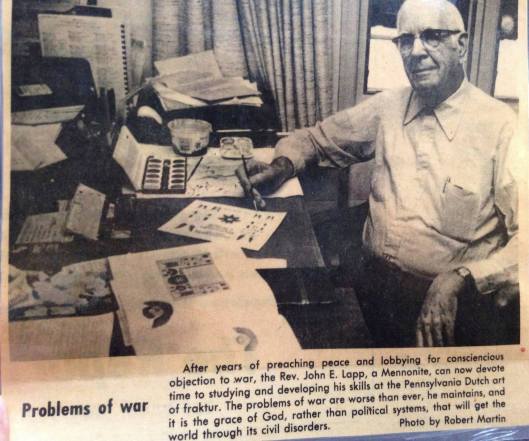
At a recent Lapp family reunion, I came across a newspaper article about my grandfather John E. Lapp.  The caption of a photo of Grandpa working at his desk, probably in the mid 70’s, reads, “After years of preaching peace and lobbying for conscientious objection to war, the Rev. John E. Lapp…can now devote time to studying and developing his skills at the Pennsylvania Dutch art of fraktur. The problems of war are worse than ever, he maintains, and it is the grace of God, rather than political systems, that will get the world through its civil disorders.” When I read this a few weeks ago, I wished I could argue with Grandpa — no, we can’t give up.  We cannot give up fighting unjust political systems; we can’t only rely on faith!  We can’t simply make art, after all, when the world is in such great need.
10532607_10204375594491407_8420969386161865534_o

How often the arguments we have with others are really about ourselves.  I don’t think Grandpa Lapp was actually giving up.  Perhaps he was in a moment of not being able to comprehend how it all ends, just as we are in this moment now.  How does this devastation in Gaza, Syria, Ukraine, Central America, West Africa, in our own communities, end?

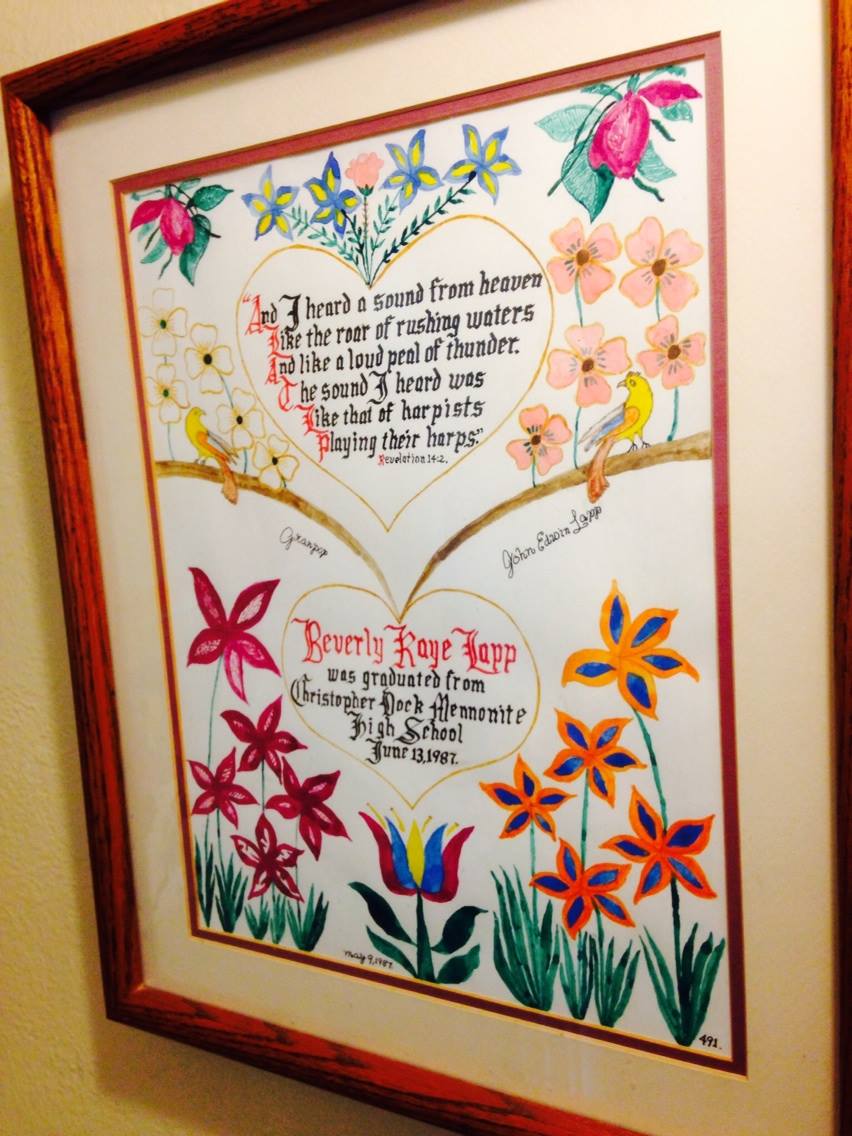
Grandpa slowed down his political advocacy but turned to art, with words, as a form of prayer, summoning the grace of God.  He made more than 500 frakturs in his retirement.  The one for my high school graduation, #491, uses the words of Revelations 14:2:  “And I heard a sound from heaven like the roar of rushing waters and like a loud peal of thunder.  The sound I heard was like that of harpists playing their harps.”  This affirmation from Bishop John E. Lapp, who for a time led Franconia Mennonite Conference in a landscape that was still not so sure about instrumental music, was a great gift to me.
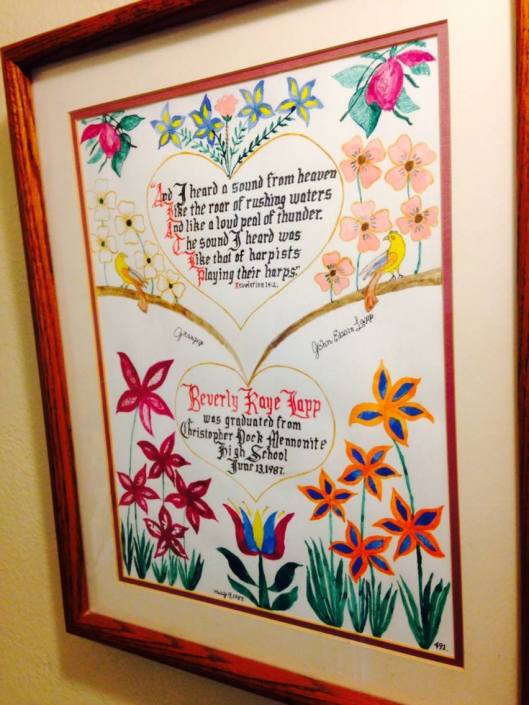
10580806_10204540559095419_4418473099409566900_o 2Words and prayer, in and with art, help us stay rooted in faith and grace, without which seeking justice can be a lonely effort.

May our worship, our extension of love in relationships with a hurting world, and our many ways of praying, help God finish what has been started in us.

I seal this time with cloth of the colors of the Jamaican flag, a place that gave me the gift of music, a place that introduced me to a hurting but beautiful world, and a place that so powerfully connected me to people seeking justice.

And I also seal this time with a song written in 1966, by Sister Miriam Therese Winter, who I understand visited Assembly in the early 1990’s.  Last weekend the Chicago friends gathered for a reunion at Camp Friedenswald, and as we sang from the Rise Up Singing songbook together, I came across this song. It became the soundtrack of my week preceding this sharing.  My family may be a little tired of it.

May these words, with one verse re-written, be our collective prayer.  As events in our world remain incomprehensible, may God’s Spirit blow in us, may God use our gifts and our efforts to fill the earth and bring it to birth.

Spirit of God in the clear running water

Blowing to greatness the trees on the hill

Spirit of God in the finger of morning

(Refrain) Fill the earth, bring it to birth

And blow where you will

Blow, blow, blow ‘till I be

But breathe of the spirit blowing in me

I saw the scar of a year that lay dying

Heard the lament of a lone whippoorwill

Spirit of God, see that cloud crying  (Refrain)


Over in Gaza the people are moaning

Rebels in Ukraine, they cannot lie still

Coming from south, the children are groaning (Refrain)


Spirit of God, everyone’s heart is lonely

Watching and waiting and hungry until

Spirit of God, we long that you only (Refrain)

Hygge

22 Sunday Dec 2013

Posted by beverlykl in Uncategorized

≈ 1 Comment

hyggeI was intrigued this past week by this article about the Dutch concept of hygge.  The happiness of the Dutch during their long winter months is attributed to hygge, a type of cozy and focused intimacy one can experience alone or with others.  The idea of hygge seems distant from what I experience as the incongruity of the longest nights of the year merging with the pressures of Christmas.  Last night I said out loud what I often feel, especially on weekends: “I am scattered!  All day I rotate between cleaning up the kitchen, working on laundry, wrapping presents, checking email and facebook, and running around town.  I want to focus on something and forget everything else but until the house is in order I can’t seem to do that.”

After my mini-tantrum, I drifted to the piano. As I practiced I experienced some precious moments of focus and bliss, even with the messes and unfinished work in the background.  It was possibly a taste of hygge, as was the moment my husband and child cuddled and giggled on the couch while reading “Diary of a Wimpy Kid: The Ugly Truth” together, and the late afternoon visit we had today with friends from Pennsylvania over spiced cider and Christmas cookies.

Tomorrow we leave for a trip to south central PA to a cottage we’re renting with my parents, siblings and their families.  Being away from the responsibilities of our own homes may help bring on the hygge.  One of my goals for the New Year will be to find the peace of mind that comes from hygge, this concept I do not fully understand but want to learn to know better through experience.

The Power of Hands

30 Saturday Nov 2013

Posted by beverlykl in Uncategorized

≈ Leave a comment

Reprinted from Timbrel Magazine, Summer 2013

After more than 35 years of playing the piano I still experience moments of amazement at what my hands can do.  I feel the same sense of wonder watching my friend weave an intricate pattern on cloth, my spouse maneuver small parts inside the engine of a classic automobile, or my colleague take the computer mouse and keyboard on an elegant dance to design a gorgeous website.  Our hands, informed by our intellect and trained by experience, can do remarkable things.

My own story with my hands began with piano lessons at the age of seven in southeastern Pennsylvania.  When I was nine, my family moved to Kingston, Jamaica for a two-year term of service with Mennonite Central Committee.  I was ambivalent about my piano studies when we arrived in Jamaica but I soon landed in the studio of the highly regarded and nearly blind Mrs. Foster-Davis.  Once I was past her foreboding gated entrance and two large guard dogs, I settled at one of her two grand pianos and she pulled out a magnifying glass to inspect my hands.  I was assigned new music that seemed far too difficult for me, but also had more time to practice in the slower culture we found in Kingston.  School ended before lunch at home and the afternoons loomed large, pulling me towards the piano to play.  The convergence of time, strong teaching, and parental support took me to a very different level of facility and sight reading ability by the time we returned to Pennsylvania.   I was no longer ambivalent; my hands were good at playing the piano.

During a teenage period in which I questioned my future direction in life there was a critical moment of recognizing piano in my identity.  A community group was preparing a production of the musical Joseph and the Amazing Technicolor Dreamcoat.  A piano accompanist was unavailable at an early rehearsal and I received a desperate call to fill in at the last minute.  The sight-reading and technical tasks of the evening’s rehearsal were daunting for a sixteen-year old, but to my surprise I was able to meet the demands.  I felt alive with awareness as my hands followed the music and during a break the director approached me with enthusiastic affirmation.  Her kind words led me to a quiet corner in the church building where I could succumb to tears of gratitude.  I thanked God for a gift to call my own and more fully embraced the possibility that the movement of my hands at the keyboard would in some way shape my future.

Over time my naïve ideas of a gift bestowed upon my hands evolved into a mature understanding of what the gift actually was.  In college I learned how to practice more strategically and as I was educated to be a piano teacher my appreciation for the concept of training took hold.  It was tempting to fall into habits of envy and comparison when observing what seemed to be superior hands in a classmate or colleague.  But every practice session brought me back to the role of training in talent development.  It was those hours invested at the piano, all the better if my mind was focused and engaged, that empowered my hands.  God’s gift to me was time and opportunity.  Every child and adult deserves this same gift of time and opportunity for talent to emerge in his or her hands, whatever the craft may be.

My hands have been through dormant stages in recent years and I worry they will lose their abilities at the keyboard.  I am reassured as a slow and steady return to the instrument wakes up my hands to find the sublime in a simple melody and the playfulness of a sprinting scale passage.  Some of the strength and agility of my teenage and young adult years is lost but I have gained more of the same with a technique that better integrates my hands, wrists, arms, shoulders, and whole body.  Some of the brash confidence of my youthful sight-reading and memorization forays is gone, but I now study and investigate the music I am playing with a more informed curiosity.  I am learning that new gifts come with age.

When someone asks, “But how do their hands do that?” about the violin virtuoso or the pottery maestro, I join in their admiration and then say, “It is amazing what training and time enable in our hands.”  Keeping my own hands moving as I grow older will be both a responsibility and a joy.

Organizing

06 Tuesday Aug 2013

Posted by beverlykl in Uncategorized

≈ Leave a comment

surfacephotoI am in a frenzy of organizing these days. I have occupied my current office for eleven years now and file cabinets from seven years in my previous office came with me. The inventory of books, music scores, and folders full of paper is massive. I run into my work space for an hour or two at a time and stare at the mess, debating how deep to go at this point. Gradually it is getting better, but not without some chagrin and even shame at how much I accumulate.

My life at home is similar. A number of closets and cupboards are being tackled this summer and here too I feel dismay over all this stuff. I long for a life of less, and yet I search out and eagerly receive more. Small disciplines help, such as removing an item for each new item, but there is an obscenity in this as well. How many trips does one make to Better World Books or Goodwill before realizing the cycle should simply stop, at least for a while?

Recently I visited a friend’s childhood home where she and her siblings spent vast hours digging through their mother’s years of hoarding. Their mother, no longer living, filled several rooms of the house to such an extent that there were only narrow passages to walk through with great care to not let the tall stacks tumble. The house wasn’t always like this; my friend remembers happy childhood years in a comfortably cluttered but orderly home. At some point her mother stopped being able to manage all the stuff.

There are now numerous books and reality shows about the psychological conditions that lead to hoarding, and plenty of resources and consultants available to help those of us with less severe tendencies. I believe good habits and systems do make a difference and with each organizing binge I am sure this time will be different. Even as I doubt what I just wrote, I think I’m actually getting better at this as I get older. Systematically, when I have an adequate space for each item in my life, I learn to not let the trouble start in the first place. Habitually, I’m learning to touch an item, whether a dirty dish or piece of paper, just once as it goes to its ultimate destination. I’m learning to bustle through a mess with more speed and purpose so I have more time to enjoy life without the mental chaos I feel when there is too much clutter. I not only yearn for the beauty of a clear surface, I remind myself that I deserve to enjoy this beauty and the clarity of mind that comes with it. We all deserve this to the extent that it works for us. I do not doubt that some are more at peace and more creative among clutter even as I’m convinced I do my best work when the house or office is pristine.

And yet, as these systems and habits become more refined as I mature, the fragility of the situation hovers in my consciousness, knowing how easily my organized stuff can spiral into an unruly jumble when systems and habits fail. Moreover, the underlying impulse to make another folder, buy another piece of clothing, or stock more food than the freezer can hold is still there. This impulse is what I hope to keep recognizing and shaping towards something more positive.

At times I wonder if my musical obsession with Bach’s WTC Book One is a coping mechanism. This is highly organized and deeply spiritual music that in my experience clarifies the mind and feeds the soul. Perhaps playing Bach right now is a way to defy the hundreds of repertoire choices sitting on my shelves, a way to empty out the chaos and breathe in the focus of a clear surface.

Time to test a theory

20 Saturday Jul 2013

Posted by beverlykl in Uncategorized

≈ Leave a comment

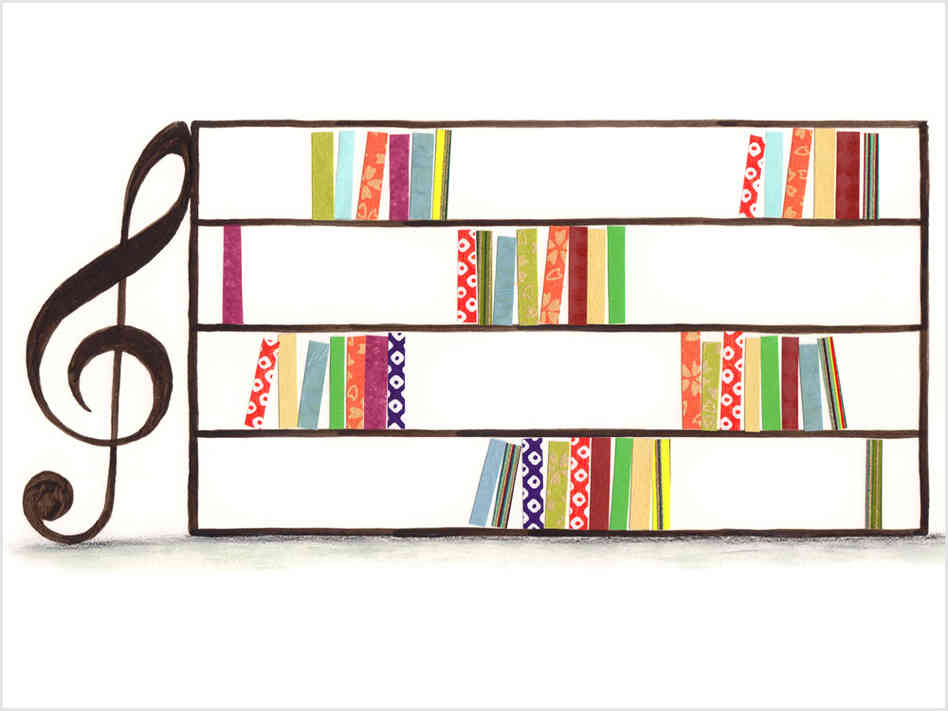
music&booksAs my last post alluded I have a new assignment at work.  I will shift from mostly teaching with a little administrative work to mostly administrative work with a little teaching. I’ll continue to chair the music department and will teach a few piano students and about one class one semester each year. For the other half of my time I will direct the Goshen Core Curriculum, our new general education program that was implemented last year. I’m looking forward to being in more focused administrative mode around two passions — a music department in a liberal arts setting and the liberal arts education of all our undergraduates — while still being able to teach some.

Before this came about I wondered what my practicing would be like if I didn’t teach as much. I am very aware of the ways in which practicing helps me integrate what I’m teaching. I have moments in practice when I notice I’m not doing what I encourage my students to do and the desire to end that hypocrisy helps me be more productive. Or a discovery, often about piano technique, is made in my own practice that becomes a useful theme in a future lesson with a student. It’s important to me that I still do some teaching so this integration continues.

I think piano practice could also be critical to my work as an administrator. Problem-solving happens as I play the piano. The other night as I practiced I found my mind wandering into messy work territory and within 20 minutes I arrived at a possible solution that helped me sleep better that night. I wish for a practice ritual each morning in which I play through several preludes and fugues to clarify my mind and set the day’s course. I hope an afternoon practice interlude, no matter how short, will energize and lead me into a few more productive hours. A benediction at the piano in the evening may help me process some lingering issues and feel some peace as I play the confident “amen” that ends each fugue.

My theory, then, in short, is that I will need to turn to the piano even more as an administrator. This new opportunity to broaden my work across campus and among the disciplines will test that theory.

(The attached image is from this NPR article)

Some Well-Tempered Years

09 Tuesday Jul 2013

Posted by beverlykl in Uncategorized

≈ Leave a comment

What if one year turns into two? Or even three? Is that so bad?

These were questions I asked myself a few weeks ago when futility was setting in about learning all 24 preludes and fugues from WTC Book One by August 2013, the one-year anniversary of the project’s beginning. The idea of the project stretching over more time shifted into firmer position when I realized that I didn’t want to be finished, even if I could be. I’m still really enjoying practicing these pieces and have no interest in moving on yet. So, A Well-Tempered Year becomes Some Well-Tempered Years and the goal moves from “I will do this by such a time” to “I will do this and I’ll know when I’m done.”

New thoughts about what it means to really know this music are emerging, and these are necessary realities to face. I can play about two-thirds of the collection, but some of this involves my fingers faking their way through some passages. The material I really know — the stuff so secure my fingers sink deeply into it with utter certainty — this sets the standard I want for all of it.

How do I maintain what I have learned when I am also learning new material? Some of that “stuff so secure” loses its edge when I leave it for a while to focus on a new piece in the collection. I’m thinking about systematic routines for maintenance, knowing that review over time is what brings new meaning to this rich repertoire. The idea of getting to the point where I have it all in my fingers to maintain is both motivating and mysterious. What will be like to have two full solid hours of this intricate music in my fingers at the same time? Is that possible? And if it is, what is the point? I want to find out.

In the midst of revitalized energy for this project and some happy times at the piano lately, other life adventures continue. A new role at work, increased social interactions that seem to come with summer, better systems in home life, clarified commitments to practicing yoga — these take time and energy. And yet, the hopefulness that I can continue with my goal of learning this full collection remains, perhaps all the more so because of how good it feels to say, “Some Well-Tempered Years.”

Recent Posts

  • You can get there from here
  • Some Sabbatical Reflections
  • Singing for Ceasefire
  • You all know this precocious little boy
  • Helen Longenecker’s Dilemma

Archives

  • December 2024
  • April 2024
  • January 2024
  • November 2023
  • May 2023
  • November 2022
  • March 2022
  • August 2018
  • November 2015
  • August 2015
  • January 2015
  • August 2014
  • May 2014
  • January 2014
  • December 2013
  • November 2013
  • August 2013
  • July 2013
  • May 2013
  • April 2013
  • March 2013
  • December 2012
  • October 2012
  • September 2012
  • August 2012
  • July 2012

Categories

  • Family
  • Higher Education
  • Knowing
  • Learning
  • Motivation
  • Music Theory
  • Peace
  • Performing
  • Practicing
  • Protest
  • Teaching
  • Time
  • Uncategorized
  • Writing

Meta

  • Create account
  • Log in
  • Entries feed
  • Comments feed
  • WordPress.com

Blog at WordPress.com.

  • Subscribe Subscribed
    • Some Well-Tempered Years
    • Already have a WordPress.com account? Log in now.
    • Some Well-Tempered Years
    • Subscribe Subscribed
    • Sign up
    • Log in
    • Report this content
    • View site in Reader
    • Manage subscriptions
    • Collapse this bar
 

Loading Comments...